
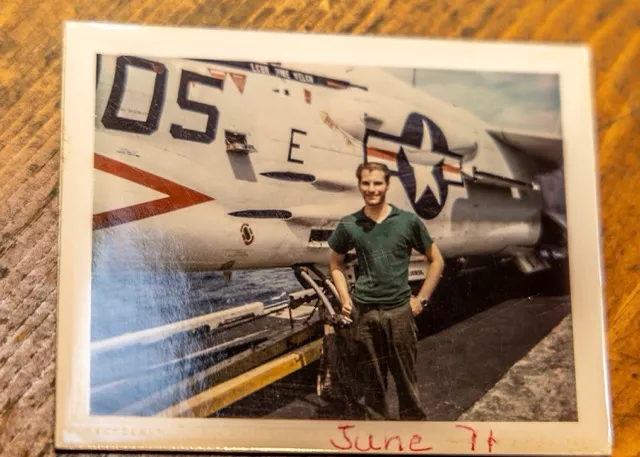
When Ed Samuelson walked into his draft board in November 1967 to simply update his mailing address, he recalled learning that his Vietnam War draft number was coming up. He pondered the choices of that day: get drafted and quite likely spend a year as an Army infantryman in the escalating Vietnam War as part of two years of active duty, or enlist for four years of active duty, choosing which branch of service was his preference, and request specialized training. He opted for choice number two, picking the U.S. Navy, for training as an aircraft mechanic.
How Did Samuelson's Vietnam War Deployment Shape His Career?
In January 1970, he deployed aboard the aircraft carrier USS Hancock in the Gulf of Tonkin with Fighter Squadron 191, a unit nicknamed "Satan's Kittens." Samuelson worked 12-hour shifts, tasked with keeping fighter jets airborne, completing two combat tours before turning 25.
"They wanted me to go on a third tour — that was my reenlistment bonus, I guess," Samuelson laughed. "I said, 'No, thank you.'"
After separating from active duty in April 1972, Samuelson enlisted in the Naval Reserve at Naval Air Station Miramar to keep his mechanical credentials sharp while pursuing civilian federal civil service work. Assigned to Fighter Squadron 301, the reserve unit's moniker felt like fate following his active-duty tour.
"It was a little ironic," Samuelson recalls. "We were called the Devil's Disciples! I don't know how it worked out, but there was kind of a flow there," from his prior active-duty days with Satan's Kittens.
A Veteran Aircraft Mechanic Career Across Two Branches
In 1980, Samuelson switched branches to join the Air Force Reserve, relocating to Indiana, working as a weekday civilian technician and training reservists on weekends. He spent his shifts servicing KC-135 Stratotanker refueling planes. But one brutal Midwest winter day convinced him and his wife to head home to Southern California.
"I went out to work on a tanker in February of '82 to change a starter control valve, and with the wind chill it was minus 60," Samuelson said. "I thought, you know, this is kind of getting old. The weather and all that; she's getting a little homesick."
He transferred to the Air Force Reserve at March Air Reserve Base.
Operation Desert Storm Deployment and the Road to a 42-Year Civilian Career
When the U.S. launched Operation Desert Storm in early 1991 — to liberate Kuwait following Saddam Hussein's invasion — the military mobilized its aerial refueling fleet, and Samuelson was back on active duty, deploying to Saudi Arabia.
"All the tankers were in Jeddah, Saudi Arabia, which was just out of Scud range," Samuelson said. "You hit one tanker out on the line, and it'd blow up, and everything else would go with it. So, they kept us down south."
Alongside his reserve duty, Samuelson built a 42-year career as a civilian quality assurance inspector for the Department of Defense. Operating across Southern California, he held final sign-off authority for up to 50 defense contractors, personally inspecting everything from combat-ready diesel motorcycles to early production military drones before government delivery.
"Without my stamp of approval, nothing was going through," Samuelson said. "There was a special form we filled out called an Inspection and Receiving Report. In essence, I would sign their paycheck."
Why Are Agent Orange Veterans Still Fighting for Health Recognition?
The decades of active and reserve duty, from the deafening roar of working flight lines to exposure to toxic chemicals, have taken their toll on the Menifee resident's physical health. The former has resulted in hearing loss. The latter has been diagnosed as causing degeneration, from diabetes to Diffuse Idiopathic Skeletal Hyperostosis (DISH) — also known as Forestier's disease — a condition causing abnormal bone growth where ligaments and tendons attach to bone, leaving his spine completely fused.
"My pain management doctor sent me for some more MRIs and X-rays, and basically my whole spine is fused," Samuelson said.
It took years following the Vietnam War for the military and government to acknowledge the human damage caused by Agent Orange. It was a defoliant sprayed aerially over the dense Vietnamese jungle to expose combatants. It was non-discriminatory in that soldiers on both sides suffered from its effects.
The Blue Water Navy Vietnam Veterans Act of 2019, passed by Congress, took effect 45 years after the war ended, covering sailors who served within 12 nautical miles off the coast of Vietnam. Samuelson is one.
He currently receives a 60% disability rating for DISH and a 10% rating for service-connected tinnitus (hearing damage) through the VA — he plans on filing for Agent Orange exposure since he has "irrefutable documentation proving he was within the 12-nautical-mile coastal boundary."
Recognition Beyond the Battlefield
Despite 30 years across two branches, and more than four decades of civilian defense work, Samuelson remains characteristically modest about civic honors and volunteer awards.
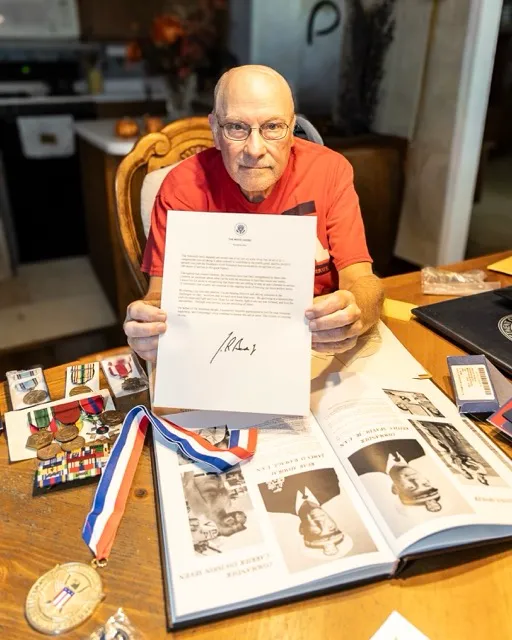
In 2023, Samuelson received the President's Volunteer Service Award, nominated by MilVet, the Murrieta-based Military and Veteran Support Services non-profit, and signed by President Joe Biden. This award recognized Samuelson's more than 4,000 hours of community service.
"I'm very proud of my service. It was for me an honor to be able to protect our freedom, to fight for our Constitution, and to keep our freedom of speech alive," Samuelson said.
"For me, it was a little odd because I didn't think I really did anything special," Samuelson said. "It's just what I wanted to do, the person I wanted to be: serving our country, helping other people, protecting our country. I didn't do it so I could get this. I did it to keep people safe."