
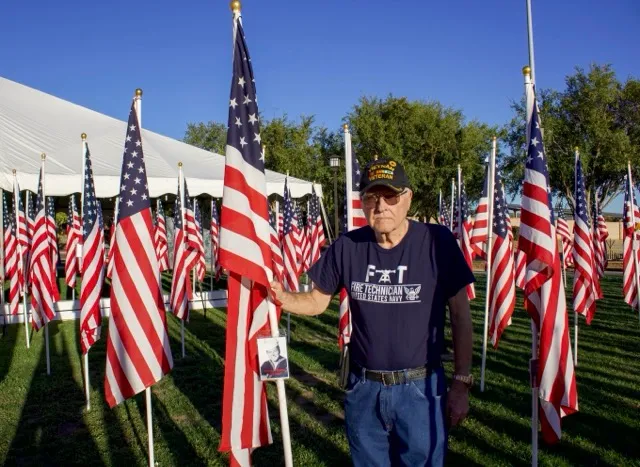
Walking along the rows of red, white, and blue fluttering flags at Murrieta's Field of Honor, weeklong patriotic display in Murrieta Town Square Park, Navy veteran Robert Morris does not have to search hard to find his place in American history — he has three personal stakes planted in the ground, a three-Generation military legacy.
Pinned to one flagpole is a weathered photograph from World War II honoring his father. Pinned to another is a portrait of Morris as a young sailor in uniform. And on the third hangs a wedding day snapshot showing Morris flanked by his three closest service buddies.
"All three of them have all passed away already," Morris said quietly. "I'm the only one left."
A Three-Generation Military Legacy
For Morris, who served four years as a Petty Officer Second Class aboard the aircraft carrier USS Enterprise, military service was more than a duty. His grandfather served in the Navy during World War I, and his father followed in World War II. By the time Morris turned 18, the United States was deeply entangled in what he calls "World War III, basically — Vietnam."
Why Did Morris Choose the Navy?
With the selective service draft registering teenage boys as they turned 18, Morris chose to take command of his own future before it was decided for him.
"They were already drafting when I turned 18 — I was still in high school and had six months to go," Morris recalled. "I wanted to be able to choose the service I wanted in, and it happened to be the Navy."
Morris finished high school and reported straight to naval duty. Recognized for his technical aptitude, he was sent to Tennessee for nine months of rigorous electronics school, training as an aviation technician to service radar and missile guidance systems.
Aboard the USS Enterprise During Vietnam
Assigned to an aircraft carrier squadron, Morris made three deployments across the Pacific to the waters off Vietnam aboard the nuclear-powered aircraft carrier, USS Enterprise. His job was high-stakes and round-the-clock: keeping sophisticated radar and weapons systems operational so naval aviators could launch, carry out combat strikes, and return safely.
Worldwide tensions escalated in January 1968 when the USS Pueblo, a Navy intelligence vessel, was seized by North Korean forces. The Enterprise and its strike group were diverted from the South China Sea, north to international waters off the Korean Peninsula in the Sea of Japan.
"They went and took one of our ships and took the crew and everything back to North Korea," Morris said. We were "on the line with the planes loaded with rockets and bombs ready to go bomb North Korea. As negotiations intensified, the Enterprise was redirected to ease tensions, without engagement.
The 1969 Flight Deck Disaster
Tragedy struck closer to home in January 1969 during Morris's second deployment, when a devastating on-board accident triggered a series of 19 explosions, igniting fires, the mayhem ripping through the flight deck of the Enterprise, off Hawaii. Twenty-eight sailors were killed, more than 300 injured, as thousands of gallons of spilled jet fuel ignited 500-pound bombs on board. Morris was present when the disaster struck.
"I was there when that happened," Morris said. "You grew up quite quick, you know."
Life After the Navy
After completing his naval service, Morris took those technical skills into a 41-year civilian career in aerospace building satellites.
Returning to the Field of Honor
Now, decades after the roar of jet engines on the Enterprise's flight deck went quiet, Morris returns each year to stand among the field of memorial flags. For him, the display is more than fabric on wooden dowels — it is a tangible reunion with his father, his late crewmates, and the quiet camaraderie that defines the veteran community.
"Just walking through there, you just feel something," Morris said at the Murrieta Field of Honor. "Everybody's there, you know? Military service teaches you discipline, and you actually learn a skill... I feel like I've done something right for the country."