
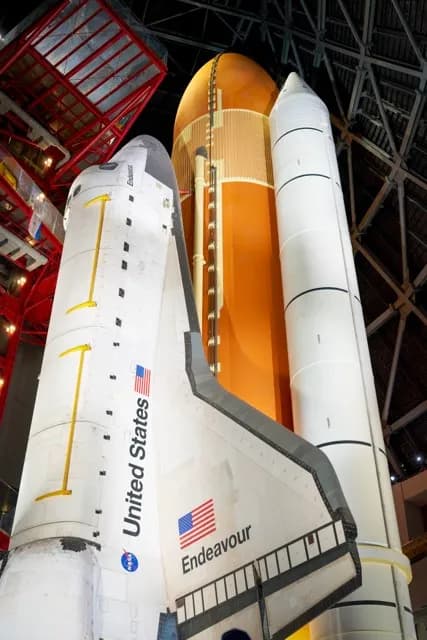
Space Shuttle Endeavour Exhibit Opens November 13 in Los Angeles
The space shuttle Endeavour exhibit opens to the public on November 13 at the California Science Center's newly expanded Samuel Oschin Air and Space Center in Los Angeles. The free permanent display marks the first public viewing of the near 20-story spacecraft sitting in its permanent perch — the world's only vertical stack of a space shuttle in its ready-to-launch position. Reservations are encouraged due to anticipated high demand, which will trigger a $4 service fee.
BY JIM FORBES
The Reveal: An Unforgettable Moment
When a curtain is literally drawn open to reveal an image unlike any other in the world, and a gaggle of seasoned, maybe even jaded, journalists involuntarily let out audible collective oohs and aahs, a tear or two is seen, a sniffle is heard, you definitely have a moment.
In a sharp film production directed by the California Science Center in conjunction with the Jet Propulsion Laboratory (JPL) at Caltech, the exploits of the retired Endeavour Space Shuttle were celebrated, culminating in footage of a past launch from the Kennedy Space Center, with the spacecraft engulfed in the voluminous plumes of smoke that accompany every liftoff.
The small theater, attended by media from across the globe, was then simultaneously filled with artificial smoke rising from below, mimicking the scene on screen, creating a time-warp sense of reality. The curtain behind the screen slowly opened in the smoky haze, revealing Endeavour itself. Sitting comfortably on its haunches in retirement, aimed at the sky, rocket boosters attached, just as it had for 25 missions to space. But now with a roof permanently over its nose.
That moment was Wednesday morning at the newly expanded Science Center's Samuel Oschin Shuttle Gallery, where the near 20-story spaceship was seen publicly for the first time, sitting in its permanent perch. The world's only vertical stack of a space shuttle in its ready-to-launch position.
“It's inspirational. Hopefully transformational. And most of all, invitational,” Dr. Ken Phillips, Curator of Aerospace Science at the center, offered in his introductory remarks.
How Can the Public Visit the Endeavour Exhibit?
That invitation to the permanent exhibit is free and will be open to the public on November 13. Reservations are encouraged due to anticipated high demand, which will trigger a $4 service fee. Entry may be limited or unavailable without advance reservations. For more information and to make reservations, visit CaliforniaScienceCenter.org.
Governor Newsom's Reaction
“I was here with my ten-year-old kid, just experienced what you experienced. I started crying as I watched.” That admission of tears from another unlikely source: California Governor Gavin Newsom.
“He was just staring. I mean, once a mind is stretched, it never goes back to its original form. He'll never forget that. It's an extraordinary thing to see that to a young child who doesn't know what he doesn't know yet. I mean, the opportunity to do that for so many millions of people, this isn't different.”
A 200,000-Square-Foot Expansion
The 200,000 square foot expansion of the science center in Los Angeles' Exposition Park, beside the famed Memorial Coliseum, nearly doubles the exhibit space.
While the Endeavour is certainly the headliner certain to draw crowds from up the street to around the planet, the opening and supporting acts in the Korean Air Aviation Gallery and the Kent Kresa Space Gallery capture the evolution of flight, both within and beyond Earth's atmosphere.
Visitors can explore a 70-foot section of a Korean Air 747 fuselage, including the main and upper decks and cockpit. At eye level and suspended from the ceilings are a Hawker Siddeley Harrier T.4a, Grumman F11F-1 Tiger, and Convair F-106A Delta Dart among a revolving collection.
The Mercury, Gemini, and Apollo programs that preceded the space shuttle are represented, as are life-size replicas of the various rovers and exploratory marvels from satellites to space probes that have explored the moon, planets, and stars.
Certain to be a popular draw are interactive exhibits, from wind tunnels to simulators and an opportunity to take a walk in space. All curated and designed to inspire visitors to dream of the possibilities.
The Scientists Behind the Exhibit
An academically diverse team of scientists, physicists, engineers, and the like were on hand to share their own sparks that ignited personal journeys in support roles, now on a mission to inspire the next generation.
“I was a horrible, horrible student. And I was in trouble all the time,” was the unexpected confession of Aerospace Science Curator Dr. Ken Phillips. “But I had an uncle,” he quickly added.
The uncle was a physics teacher in a Washington, D.C. high school that was relocating to a new facility. He hired young Ken for “10 bucks a week” to move the physics material from the current lab to the new one. “And I became absolutely fascinated in the lab because…I learned that physics was this thing that really showed you there is an invisible set of forces that control the world you see.”
“The spark that got me to where I'm standing here started with Carl Sagan,” JPL group supervisor Dr. Moogega Cooper revealed.
The famed late astronomer was a major influence on the early missions to Mars. He had a particular interest in ensuring that missions to the red planet did not deposit contaminating microbes from Earth to Mars.
Sagan and his popular TV show were a respite from a childhood that Cooper says was replete with “all types of terrible situations. But this was my North Star, science exploration.” Like Sagan, her work focuses on preventing mutual contamination as we explore Mars.
For JPL's Dr. Steven Lee, the spark was simple. Neil Armstrong and Buzz Aldrin were the first humans to step onto the lunar surface on Lee's seventh birthday. “So if you want to inspire a kid for a career in space and exploration, land on the moon for the first time on their seventh birthday.”
“We all yearn to understand and explore,” Lee adds in a sustained tone of wonderment. “And that's really been a motivation for a lot of us who worked on these missions. And it's a real privilege to really be at the cutting edge, and in some ways, be the pioneers of exploration.”
Why This Matters
Curated by Dr. Phillips, supported by Drs. Cooper, Lee, and so many others, the intent is for the expanded science center, now nearly doubled in size, to peel back the curtain of possibility. In the words of the one-time “horrible, horrible student,” Dr. Phillips, “It's about understanding who we are, where we are.”