
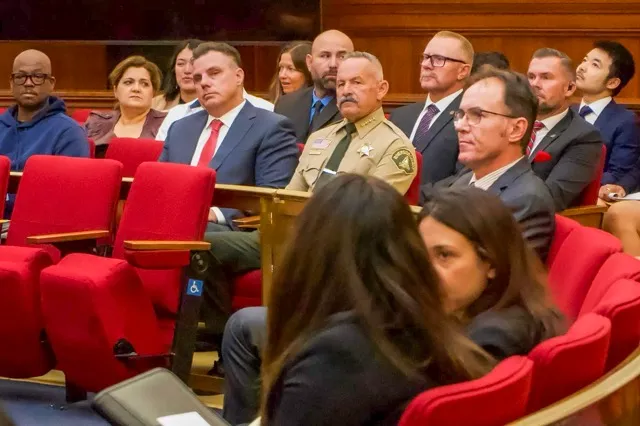
RIVERSIDE (CNS) - Riverside County Sheriff Chad Bianco is looking for the county to foot the cost of his legal contests stemming from state lawsuits over his investigation into alleged election fraud.
According to published reports last Friday, Bianco has filed a claim in Superior Court looking to obtain in excess of $10,000 to cover his court bills, though the specific amount wasn't cited.
Why Is Bianco Seeking County Funds?
Last month, the California Supreme Court ruled the sheriff had overstepped his authority in disregarding Attorney General Rob Bonta's order earlier this year to stop the probe into alleged election fraud.
The case of Bonta v. Bianco stemmed from the sheriff's investigation into alleged fraud in the November 2025 special election.
How the Election Fraud Investigation Began
Investigators obtained three search warrants from a county judge, leading to deputies' seizure of roughly 1,000 boxes of vote-by-mail ballots cast countywide.
Bianco, at the time a Republican gubernatorial candidate, put detectives on the case after a civic watchdog group, Riverside Election Integrity Team, said it had uncovered discrepancies in the official ballot count. REIT said it found a difference of 45,896 ballots between what the Office of the Registrar of Voters stated had been cast, compared to what was actually counted -- 611,426 versus 657,322, according to court documents.
"There is no acceptable error, small or large, in our elections, let alone a 45,000-vote difference," Bianco said in March.
The Attorney General's Lawsuit and Legal Fight
Bonta directed the sheriff to halt his investigation and return all of the seized ballots, saying the sheriff was trampling on constitutional processes, and that any investigation into possible election corruption should be handled at the top. Bianco agreed to pause the investigation but publicly challenged the attorney general's authority to interpose in a county-level probe, culminating in the AG's lawsuit, as well as an analogous suit by state Sen. Sabrina Cervantes, D-Riverside.
Bianco's attorneys argued before the Supreme Court that Bonta, in fact, was not empowered to dictate to an elected sheriff to stop carrying out an investigation, but rather only to supersede a sheriff's actions when there was evidence of "under-enforcement" of the laws. The defendants said such matters were recognized by the legal precedent of "substantial authority."
What the Supreme Court Decided
The justices found the argument inapplicable. They turned to the plain language of Article 5, Section 13 of the state Constitution, going back to voter-approved measures in 1934. The relevant provision says the attorney general "shall be the chief law officer of the state."
"The attorney general shall have direct supervision over every district attorney and sheriff and over such other law enforcement officers as may be designated by law, in all matters pertaining to the duties of their respective offices," according to the provision.
The issue over the disconnect in the ballot count was never entirely resolved, although county Registrar of Voters Art Tinoco attempted to explain potential reasons for the discrepancies during an appearance before the Board of Supervisors last February.
He said "The handwritten records that REIT's calculations relied upon were prone to human error and did not account for certain kinds of ballots," according to the court's opinion.